The Drunken Gardener, Part Two
Henry starts a new family

We continue with Grandaunt Flora’s memories that take up the story in the hill station of Simla (now called Shimla), Punjab, India, in 1871:
“…so he [Henry Bwye] was employed to construct the public gardens at Anandale, and subsequently to level the ground and fashion a natural arena to accommodate a race course and other sports amenities such as horse shows, gymkhanas, golf, cricket and football. I well remember the gardens being very reminiscent of Kew, with fine heated greenhouses, pergolas and a wealth of exotic plants, still flourishing in the 1940’s when we left India.”
In Part One, Henry had left his job as Superintendent at Ram Bagh, Amritsar, and on the way to Simla his wife, Caroline, died of consumption at Ludhiana. Less than a year later, his youngest daughter, Kate Rolfe, died in Simla.
Henry’s sons, Frank Clifford (abt. 9) and Harry (abt. 12) were still alive, and most likely had accompanied him. So it would have been a matter of some urgency to find a new wife. Henry quickly found Martha Morrison nee Gill, a widow at 35, who had three sons (who were 17, 13 and 4) and married her on 22 Apr 1872. It is quite possible that she was already pregnant with their first-born son, Willie, when they married, as he was born only seven months later.
On Willie’s baptism record1, Henry’s occupation is given as “Horticulturalist Lesse of the Annandale Gardens, Simla”. ‘Lesse’ could be a misspelling of ‘lease’, meaning that he had been leased out as a horticulturalist to Annandale, but this is by no means certain. However, it could back up Flora’s claim that he was covenanted as a Kew Gardener to India. In any case, it certainly clarifies that he was employed at Annandale.
Annandale was a large area about 2 km north of Simla railway station and below the colony of Kaithu. The origins are somewhat unclear. Some say it was named after the Annandale valley in Dumfries, Scotland. Others say that the name is ‘Annadale’ and it is named after a woman called Anna, who was loved by Charles Pratt Kennedy, the man who was tasked with finding the summer capital of India for the British government2. Simla was indeed the summer capital where the whole civil service and military administration fled to during the hot summer months.
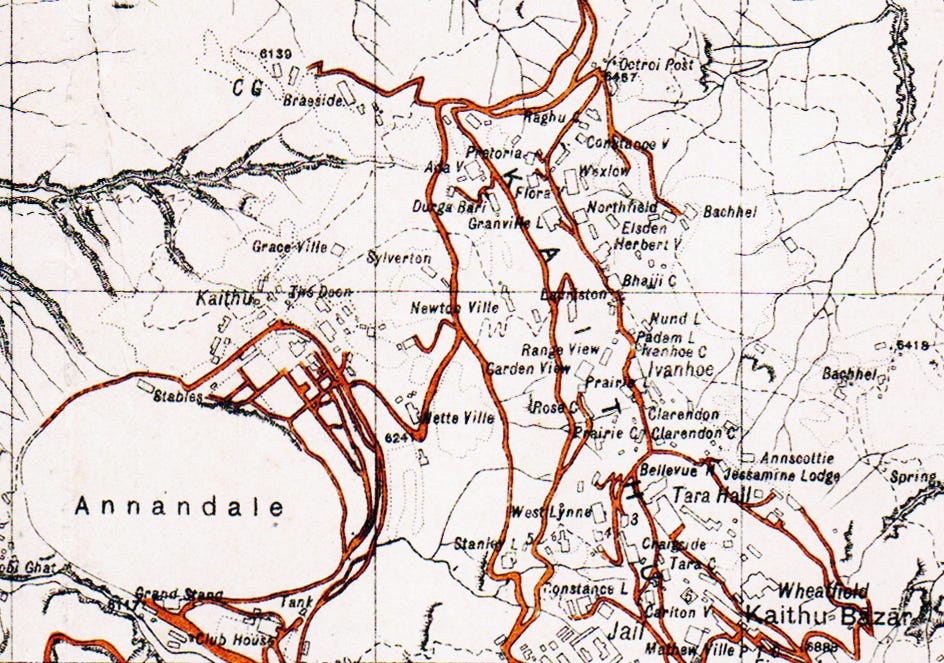
Annandale was a place of entertainment for the British and had a clubhouse where the head gardener would have been accommodated. Gymkhanas, festivals and sports, such as polo and cricket, took place there, as well as army parades and training3. It is also a disputed fact that Colonel McMurdo laid out the gardens in 1852, affiliating them with the Agricultural Society of the Punjab, to host a collection of indigenous alpine trees4. Edward John Buck maintains in “Simla, Past and Present”, however, that the gardens were established earlier, in 1847, by Dr. William Jameson, Superintendent of the Saharanpur Botanical Gardens. Buck also names Alfred Parsons, a Kew gardener who had previously worked in the gardens at Ajmere and for Lord Mayo’s Cotton Commission, with the supervision of Annandale. However, Parsons first came to Simla in 1881 and was appointed municipal gardener from 1882 to 1895, when he resigned (because the authorities wanted to reduce his salary), and left the clubhouse at Annandale where he had lived5.
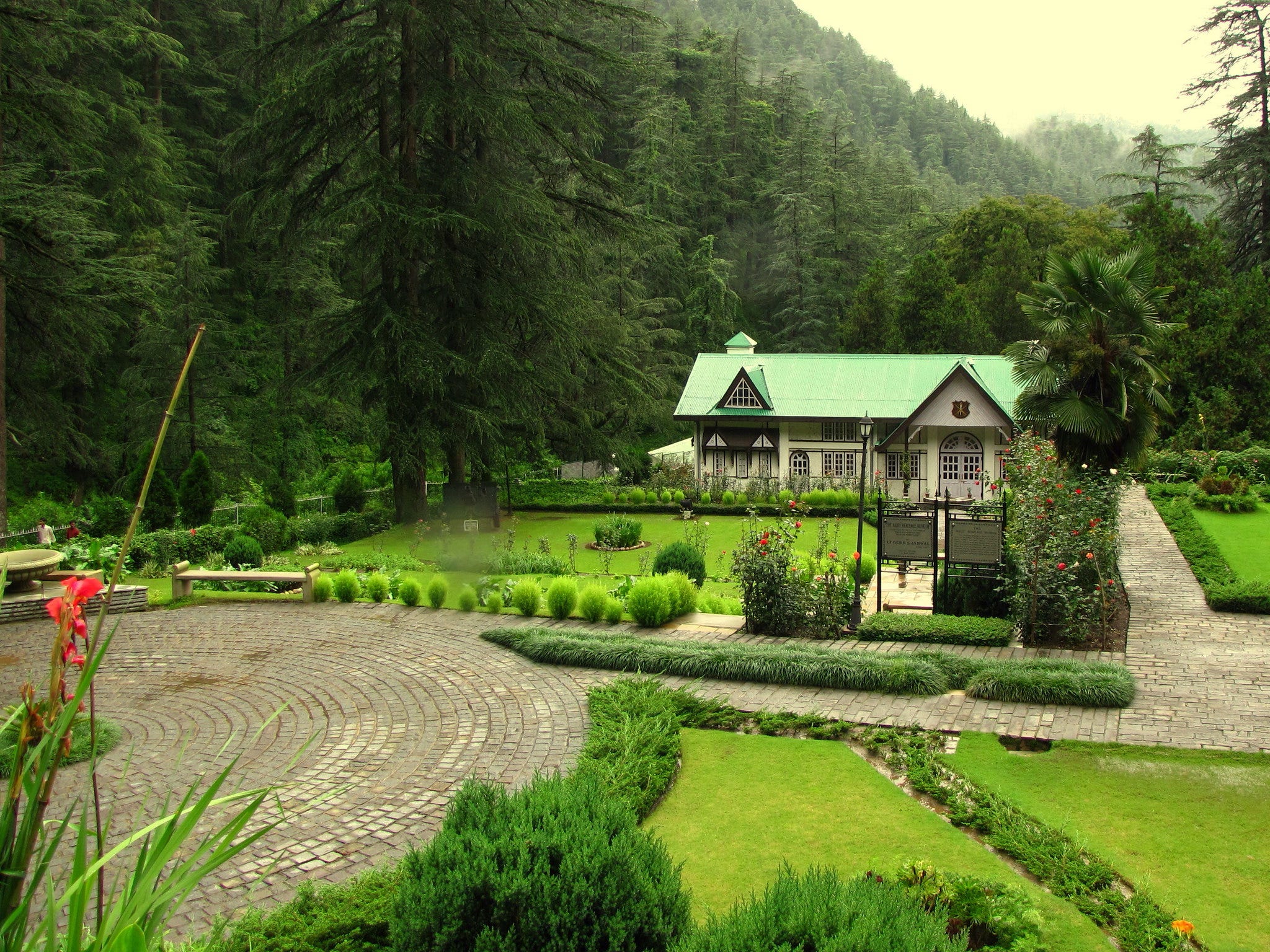
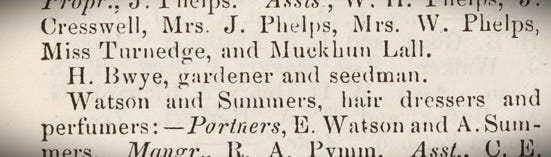
This suggests that between at least 1872 and 1882, Henry could have been the supervising gardener at Annandale. Having been the Superintendent at Ram Bagh, it is unlikely that he would have been anything less than the head gardener at Annandale. Indeed, he may have also worked on other gardens in the area, as he certainly advertised his trade, as a newspaper article from 1874 shows, as a:
“Practical gardener, seed-man, and florist, collector of coniform and other seeds, Simla, Punjab, India. Plans designed and prepared for the laying-out and improvement of gardens; the erection of horticultural buildings, and work relative to horticulture undertaken.”6
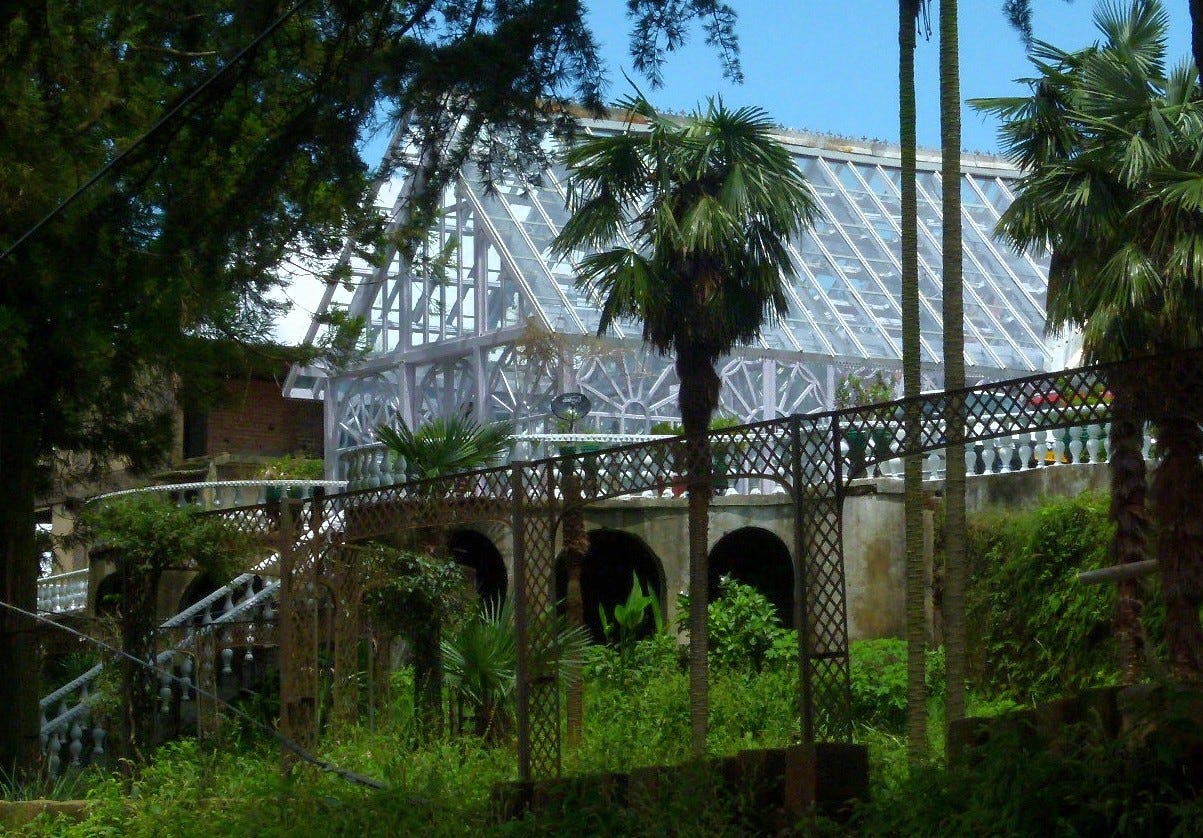
There is even the possibility that he was the “European gardener” that laid out the Rothney Castle gardens in Simla with its beautiful glass house7. There was noone else advertising their horticultural services in Simla at the time Allan Octavian Hume acquired the castle (abt. 1871).
Henry and Martha’s family was also growing steadily: Flora Harriet (my great-grandmother) was born in Spring of 1874, Fred Gill in 1875 and Ada Gill in about 1878. On the various baptism records, Henry was described as either a ‘horticulturalist’ or simply a ‘gardener’, but there is no further mention of Annandale.
Let’s refer to Flora’s memories again:
“Martha’s four children were born in what was later to become the Gymkhana Club house at Anandale. Unfortunately her husband, although a brilliant and charming man, proved to be an alcoholic. My mother [Flora Harriet Ruegg nee Bwye] said he was a very handsome man, but very wild when drunk, and ill-treated my grandmother so much that her two grown step-sons ran him out of the house and secured his return passage to Britain. The family never heard of him again, poor man!”
This seems to confirm that Henry stayed at Annandale at least until 1878 when Ada was born. At that time, the two grown-up stepsons were most likely Harry (19) and Frank (16), showing a loyalty to their stepmother that gives credit to her. But it left Martha with a houseful of children and no husband, and no roof over her head, as the clubhouse went with the job.
But this is Henry’s story, and Martha’s story you can read here.
Of course, alcoholism is rarely documented so it is not at all clear when Henry started to hit the bottle, nor do we know if his work was badly affected by it. We also don’t know when exactly his step-sons took action and threw him out of the house. We only know that Alfred Parsons took up as head gardener in Annandale in 1882.
Did the municipality ask Henry to leave because his condition had deteriorated? Why is there no official record of his position there, only one entry in a baptism record explicitly naming Annandale, and a listing in Thackeray’s Directory as a ‘gardener and seedsman’ from 1874 to 1885?
Flora says that he was sent back to Britain by his sons and he was never heard of again. There is, however, no record of him taking a passage on any ship back to Britain, nor any record of him to be found in Britain after 1882. One of the other genealogists in the family believes that he stayed, or came back to, India and died there in 1901. But there is also no record of that. He literally disappears.
What is left behind is a faint trace of a ‘brilliant and charming man’, a horticulturalist and landscape gardener, who could have been remembered for the beautiful gardens he created. Instead he disappeared into the mists of time because of the evil drink. We will never know why he turned to alcohol, perhaps because of the loss of two children from his first marriage and his wife, Carry, all in such a short space of time. Death in the colonies was rife: the heat and the lack of sanitation combined to kill all but the very strongest. India was not the glittery Jewel in the Crown for those sent out to fashion its land in the style the wealthy British were accustomed to. The fine greenhouses, pergolas and exotic plants that Flora describes required extremely hard work to flourish, especially in India.
Baptism: “British India Office Births & Baptisms”, Reference: N-1-142; Folio: 331; FindMyPast Image - FindMyPast Transcription (accessed 19 January 2026); Willie Bwye baptism on 29 Dec 1872 (born 11 Nov 1872), child of Henry Bwye & Martha, in Bengal.
Lohumi R: Ground of Contention, Tribune News Service, 19 Apr 2012
Consequences, Rudyard Kipling in Plain Tales from the Hills, 1888 (Kobo); Cupid’s Arrow in Jungle Book (1895); Coolie, Mulk Raj Anand, 1936
Carey WH: Guide to Simla, 1870
Buck EJ: Simla, Past and Present, 1904
‘Gardening in India’, Mayo Examiner, 21 Dec 1874: “Simla, having a resident population of six thousand, and full twelce thousand more as visitors, has gardens numerous enough to support a professional whose card is now before me, and may be useful for reference to some of your readers, so I copy it:— H.Bwye …”
Sharma JP: Glass in the Garden: building the glass house in British India, 2013, p.12: “Hume’s estate, called Rothney Castle … was bought by Hume in the 1870s. Hume employed a European gardener, to lay out the grounds and build a museum for his large ornithology collection as well as a conservatory for his horticultural exhibits. Once again while the identity of the gardener is not known, it could be speculated that Rothney Castle’s gardens and conservatory were laid out under the supervision of Alfred Parsons.”
Since Parsons did not come to Simla till 1881, it is more likely that Henry Bwye was the ‘European gardener’.
I can't help feeling a little sorry for Henry ... What makes a "a brilliant and charming man", as Flora described him, derail himself like that? I hope the shock of being thrown out 'woke him up' ... I suspect not ... I do hope you eventually find out. As for Martha - such a strong and admirable women who, with a little help, got on and made the best of things. You have done a great job on Wikitree with this family!
What a mystery! I hope you find out what happened to him one day...