
My fourth great grandaunt Lydia Frances Ruegg might be only distant family, but she certainly added some colour to the family tree when she gave birth to not one, but two artist sons: Horatio Henry and Bertram Allan. To be fair, she did not produce them alone: her husband Robert Hall Couldery was also an artist, though he started out as a butcher, like his father.
Lydia and Robert married in 1829. She was the daughter of a Swiss emigré, Ulrich Ruegg, who ran a pub called the Sergeant’s Head in the St Catherine’s Precinct, and Sarah Thornton from Stepney. Lydia and Robert had eight children, all of whom were given very grand names and were born in Lewisham.
Horatio Henry Couldery
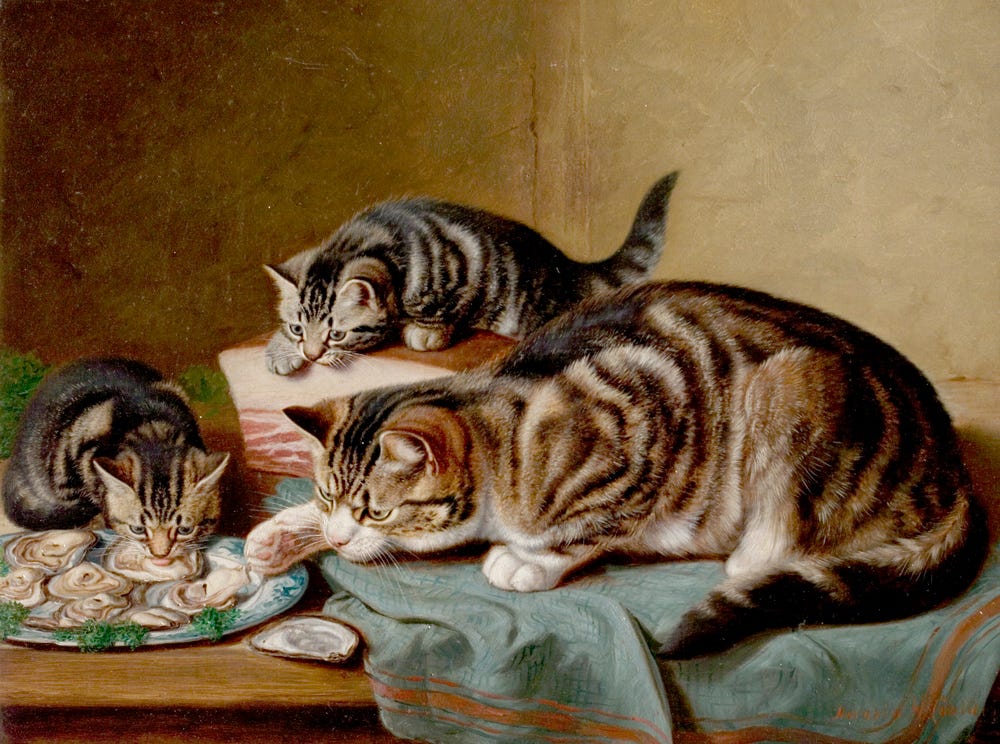
Horatio Henry Couldery (1832-1918) was the third child and became the best known of the artists in the family. He was a prolific painter of animals, especially cats, and became known as “Kitten Couldery” for the abundance of sweet kittens prancing around in kitchens, stealing food, playing, and being generally naughty. Horatio also painted dogs, ducks, fish, mice, pheasants and rabbits. He exhibited at the Royal Academy, the British Institution and the Royal Society of British Artists, as well as many other galleries. He was also known as an illustrator of childrens’ books and greeting cards, and often painted pieces to commission.
Bertram and Cecelia Couldery
Horatio’s brother Bertram Alan Couldery (1838-1911) was a lesser known artist. Like his father he preferred painting landscapes. Nowadays we are all well aware of the instant appeal of kittens and puppies, so his artwork was not as sought after as Horatio’s. He is sometimes described as “amateur” or that he painted as a hobby, but his real strength lay in his expert copying of great artistic works, for which he received some reknown1.
Bertram married Cecelia Angelina Ricketts (1841-1904), who also painted. She focussed on painting people and several paintings are attributed to her that can be found in the Couldery Collection, especially “The Chess Game” of her and her husband, Betram, playing chess. There is a photograph of the moment that likely she used to paint from2.
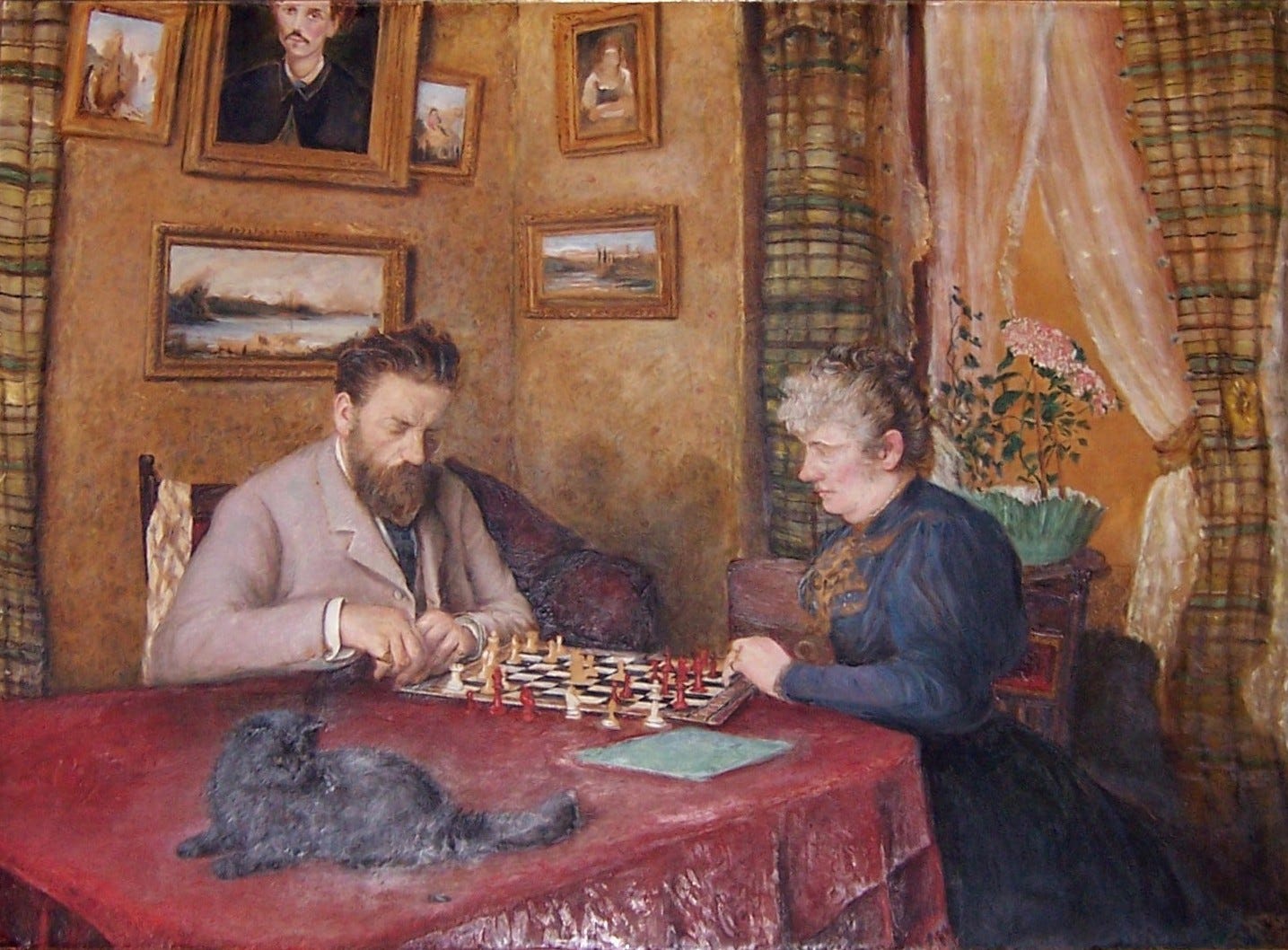
On the 1871 census, Bertram is described as a “landscape painter” and Cecelia as a “portrait painter”. By the 1880s they had half-emigrated to Canada and began collecting art and antiques. They had a house in Belleville, Ontario, and travelled back and forth by ship to England, which must have cost a great deal in both money and time. Indeed, the question arises as to where all the money came from. Robert Hall Couldery had also become an artist, but he barely makes a mark on the internet. So I began looking at Cecelia and where she came from.
Cecelia’s family
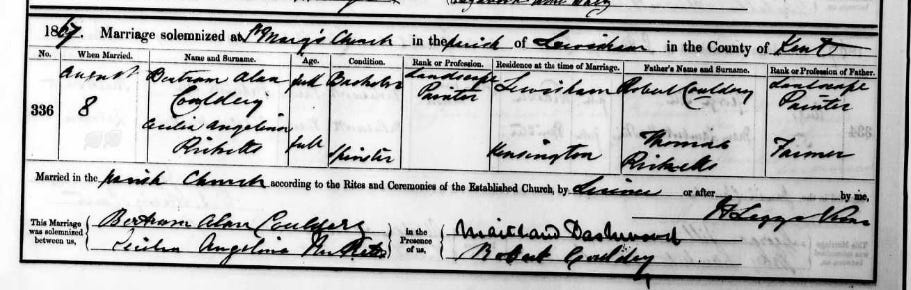
The marriage announcement between Bartram and Cecelia is in a great many papers, suggesting that they came from a wealthy family. Cecelia is described as the only daughter of Mr Thomas Ricketts, Esq. of Pembrokeshire, Wales.

The 1871 census tells us that Cecelia was born in Bristol and was 29 years old. I found a record that says Cecelia Angelina, daughter of Thomas and Elizabeth Ricketts was baptised at St James’ church in Bristol, and Thomas was an “eating house keeper” (in other words, the owner or manager of a public dining establishment or small restaurant).

However, on her marriage record, Cecelia’s father is described as a “farmer”.
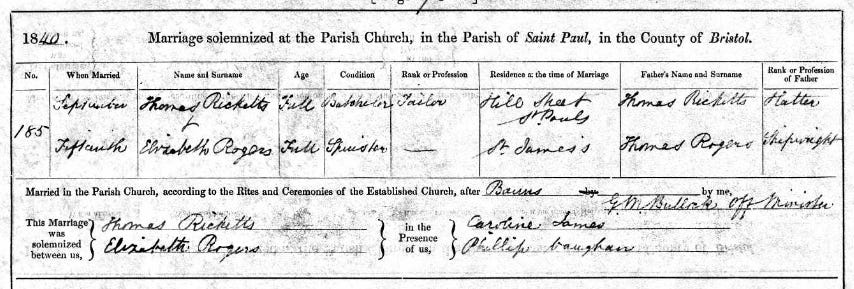
There are no census records that show where Cecelia lived before she married. So I looked for Thomas Ricketts, her father, in Bristol. Cecilia was born in 1841, so I searched for a marriage in St James parish of Bristol in 1840, and there he was: Thomas Ricketts of Hill Street, son of Thomas, a hatter. He married Elizabeth Rogers, daughter of Thomas Rogers, a shipwright. However, Thomas was a tailor in 1840.
Elizabeth Rogers sounds about right, as in the 1871 census, Cecilia had her cousin Ellen Rogers (15) living with her at 3 York Villas, Lewisham.
In 1841, shortly before Cecilia was born, the census shows her parents living in Broadmead, St James. Thomas is 25 and he is a victualler.

In the 1851 and 1861 censuses, we find a Thomas Ricketts living in Frocester, Gloucestershire, near Stroud. This man is a farmer who originally hails from Frocester, lives at Osborne House, and has a farm of 200 acres, employing seven men and two boys.

But if this is our Thomas, how did he get to Pembrokeshire and when? It doesn’t fit that Cecelia is his “only daughter” in 1867, but in the 1861 census he has sixdaughters and one son. So perhaps we can discount this Frocester farmer, although he clearly is wealthy, with a governess, a general servant, a nurse and a nurse girl in his employ.
Tailor, eating house keeper, victualler, farmer. A strange procession of occupations. None of which led me to a wealthy Pembrokeshire gentleman.
Approaching the search from another angle, I found a electoral register record in 1876 for Bertram Alan Couldery who owned a house and land at Baldwins Moor, in the parish of Manorbier, Pembrokeshire.

But this lead doesn’t take us any further. Annoyingly, Google’s AI keeps hallucinating there is a strong Pembrokeshire connection and that Bertram was fond of painting the Pembrokeshire coast, but none of the sources provided back this up (another reason not to use AI for research: sends you off on even deeper rabbit holes).
So there we have it: a brick wall. I can’t find the source of the money that financed the Couldery Collection.
Adoptive Daughter
Moving on: the Coulderys became friends with a family in Canada called the Docters. William Docter was a hotel keeper. They adopted their daughter Ann Susannah Docter (1868-1956) and brought her back with them to England. This is interesting, because Ann’s parents William and Ann Docter were both still living. The friendship must have been very close, as William and Ann named two of their eight children after Bertram and Cecelia.
By 1901, Ann is 32 and living with the couple in Beckenham as their adopted daughter3. When Bertram died in 1911, Ann inherited the estate, worth over £2,000, including the whole Couldery collection. In October 1955, 88 year old Ann — who had married Willie Salaman in 1913 and continued to live in Ventnor on the Isle of Wight — sent the collection (now worth over £6,000] to Belleville, Canada, and died herself the following April.
The Portsmouth Evening News said that most of the paintings were the original works of Bertram and Cecilia Couldery, and that Ann Saraman also provided a trust fund for the erection of an art gallery to house the collection which she had kept in her home in Ventnor up to that point4.
Eight years later, the paintings were shown for the first time, having been in storage the whole time. The Hastings County Museum showed only about thirty of the “several hundred oil paintings” because of lack of room, and included works by Bertram’s brother Horatio5.
“Mrs Couldery was noted as an accomplished portrait painter, and her husband as a landscape artist. The display also includes several works by Mr Couldery’s brother, Horace (sic), who was noted for his “many life-like animal studies”.
Today, the Couldery Collection resides in the Glanmore Museum, a national historic site of Canada, in Belleville.
Cecelia’s death and resurrection
The next strange twist I encountered in the research of this Artist couple, was when I got to Cecelia’s death. Quite clearly the probate document states that she died on 15 July 1904 at 19 Beaumont Street in Marylebone, her last address being “Coniston”, London Road, Norbury, Surrey. Her estate (just over £548) passed to her husband Bertram.

All fine and good. Until a record turns up for a passage on the ship “Victorian” to Montreal, arriving on 16 May 1908. There it is in black and white: Cecilia Cauldery (70), Ann Cauldery (39) and Bertram Cauldery (69).

Unless… that is not 70, but 20. The youngest Docter child was born about 1887 and christened Cecilia Couldery. So perhaps not a resurrected Cecelia, but another of the Docter children was on her way back to Canada.
There’s still a way to go with the Coulderys. But I’ll leave it there for now and hope that some of you bright researchers in the genealogy community might come up with a brainwave. I’d love to find Cecelia’s Pembrokeshire father or find out if the Bristol Thomas made good after trying out various occupations. Send me a comment with your ideas, I’d love to hear from you.
All the vital sources are on these Wikitree Profiles:
Cecelia Angelina (Ricketts) Couldery
Glanmore: The Art of Copying, with examples of Bertram Alan Couldery’s works.
Photograph of Bertram and Cecelia playing chess on Glanmore database.
1901 England Census, Class: RG13; Piece: 687; Folio: 21; Page: 34; ED, institution, or vessel: 01; Household schedule number: 133. Household of Bertram Couldery (62) in Beckenham in Bromley registration district: Cecilia A Couldery (58), wife; Annie S Docter (32), adop daur; Lilly M Dore (21), housemaid; Alice Warne (19), cook.
Portsmouth Evening News: Gave Canada Paintings, 21 Apr 1956, p.7.
Intelligencer: Pictures Will Be Shown for First Time, 1963, accessed via Internet Archive, 5 Sep 2026.
What a fascinating family and I'm sure I've heard about the painter of kittens or maybe it was just the popularity of these paintings.
Thinking about the money for travelling between UK and Canada, I wondered if there had been some money passed down through the family starting with the Swiss emigre and I'm sure the Canadian family who's daughter was "adopted" would have provided some money too.
Are you related to the Compton Hall's??
The Coulderys were definitely blessed with artistic genes. I love cats and An Oyster Supper is very cute.