Mary's Wedding
9 Apr 1817, Garrison church, Fort William, Calcutta.

I wrote this piece responding to a prompt from Robin Stewart for Genstack Coterie. It is a first draft depicting one scene in the life of Mary Byrn, my 3rd great-grandmother. This is a fictional piece of writing, drawn from a marriage record. I am actively looking for feedback on it: what works best for you, what might be improved and how, and whether you get a sense of how she felt. Is there something missing? What I am not seeing that is needed?
I stood in front of the Garrison church at Fort William. Lieutenant-Colonel Imlack was beside me, stiff as a board. Inside the church was my future. With a man whose name I knew and I had met once. Long enough to say yes, although I am not at all sure that I could have said no.
My name is Mary Byrn and I am an orphan at the Lower Orphan School near Calcutta. Although I carry the name Byrn from my father, I don’t remember what he looked like or even his first name. I know even less about my mother, who last held me in her arms when I was very small, maybe three or four years old. I don’t know where or how we lived or if my parents are alive. Home has always been the old school in Howrah till recently when we packed our bags and moved to Barasat temporarily, until the buildings for the new School at Alipore are finished.
Inside the church is the man I am to marry, George Gill. He is 21 and comes from England, from a village in Yorkshire – so I have been told – and was a weaver by trade before joining the Company to fight in India. He is a Sergeant in the European Regiment, a good position, and by all accounts that means he can afford a wife and children.
A wife and children. What does that mean? At the school I learned needlework and how to keep a house, but precious little else. I don’t even know what a man looks like under all that uniform.
Now we are entering the church. George – can I call him that? – is standing in his red coatee tunic and white duck trousers. He wears a black hat with a shiny metal plate with a lion on it, I think it’s the sign of the Company. Looking at his face, which is not really handsome but also not hardened or ugly, I see that he too is nervous. Under one eye there is a slight tic and he is very still indeed, his hands clasped tightly behind his back.
Beside him stands another soldier. He was with him at the School when he first came looking for a wife, and I know him as William Cox. That was less than a month ago. Afterwards, I said yes to marrying George – knowing that Imlack was wanting to see the back of me, as I was already seventeen. That’s two years beyond the age permitted to stay at the School and it was either marriage or service to a European lady. There weren’t that many European ladies looking for a maid and none was found in the last two years.
George told me that he would treat me well, but that life is hard in the cantonments and even harder in the camps. By way of my dark skin, he thought the sun would not be a problem. And as I was born and lived in this country all my seventeen years, I would be less likely to get ill. He spoke as though he were buying a horse, not taking a wife. At least he didn’t ask to see my teeth, as I had lost some. Otherwise, I am healthy enough. I can’t say that about many of the children in the School – last year, cholera took a lot of them.
We are standing side by side now. I can smell him. Maybe it is his uniform that has the smell of battlefields and death, or maybe it is just unwashed. Is that what I will be doing tomorrow – washing his clothes? Or washing him?
First, we’ll have to get to the camp. If I am lucky they will have given him a carriage to bring back his new wife, and not just an old bullock cart. It will be a long way and a taste of the many roads to come. What will be at the end of it, I can’t imagine. I hear tell that the camps are very big indeed, sometimes many hundreds or even thousands of people, all sorts. My only hope is that I can make friends with other women who will show me how I should live, what I should do. Or maybe George can tell me on the way what I have to expect, although he didn’t seem like a big talker when he came to the School.
The Chaplain is asking me to say ‘I do’ to the vows. I look down at my plain dress, lent to me by the school for this special day. Even the shoes are not mine. I think to myself: you have no choice, just say it, and be done. So I do.
As we come out into the blazing sun together, I look across to the beautiful white buildings of Fort William with its dome and towers. Every day we saw the Fort from the School in Howrah, over the Hooghly River.
I look at my husband and he smiles back at me and asks, “Are you ready?”
I am not, but how can I say to him that I can’t ever be ready to leave my home, my friends, and go with him? To go into the unknown, the unimaginable. How can I say I am frightened of what the future will bring, of him and his desires, and of making children? I can’t say these things. So, once more, I just say “yes”, as though the word “no” was plucked out of me. This will be my life. A life full of saying yes to whatever will come.

Looking forward to your feedback!
Author’s Notes
I have done quite a bit of research on Mary and George, my 3x great-grandparents, but I have not found anything more about their parents, despite many queries on social media groups, and digging through the whole FIBIS database. This is what I did find, that is relevant to this story:
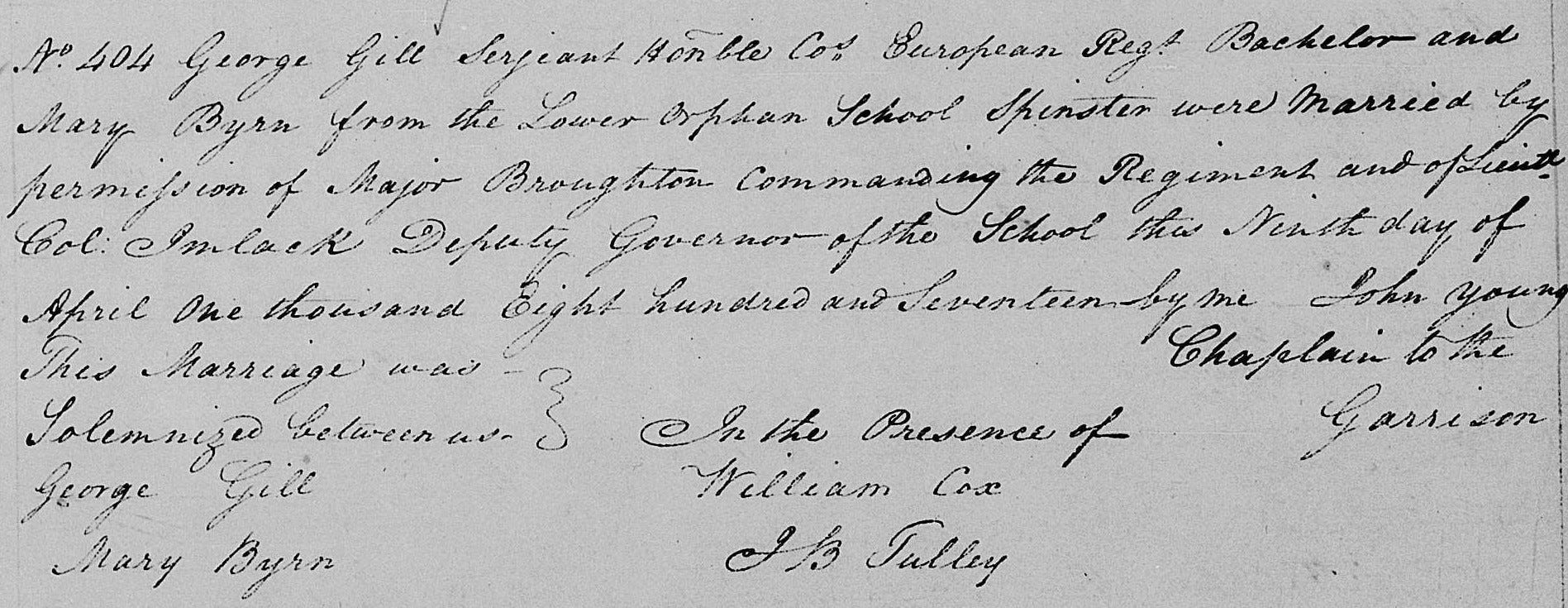
As can be seen in the image above:
Mary and George were married on 9 Apr 1817 at the Garrison church, Fort William, by the Chaplain.
George was a Sergeant in the ‘Honorable’ East India Company Europan Regiment. The commander of the regiment, Major Broughton, gave permission for the marriage.
Mary was a ward of the Lower Orphan School (LOS).
The marriage was permitted by the Deputy Governor of the LOS, Lieut.-Col. Imlack.
The marriage was witnessed by William Cox and J.B. Tully.
I do not know if William Cox was in the same regiment, or if he came to the LOS to look for a wife, together with George. However, he may have been his best man and it was fairly common practice that comrades or brothers went together to look at what the Orphan Schools ‘had to offer’. I have found other such instances with George and Mary’s sons.
The record of George’s military service1, found on the FIBIS database, showed the following about him, among other information:
His previous occupation was as a weaver
The town he came from was Bradford, Yorkshire, England
He enlisted on 22 Mar 1811 and came to India on the ship ‘Minerva’
On the basis of this and further research, I found a George Gill who was born in 1796 in Gomersal, Birstall, near Bradford. This may be him, but it is not verified. If it is, he would be 21 and would have enlisted at 15. His burial record in 1871 gives his age as 762, so this would fit approximately.
Contextual information on the practice of removing children from soldier’s families, especially those in mixed partnerships, at age three or four, as well as the LOS at Howrah/Allipore come from various sources3 From these I found out that the LOS moved from Howrah to Allipore, but was temporarily housed at Barasat due to an outbreak of the disease opthalmia. Information on what the children were taught and when they were expected to leave the school, or how, were contained in these sources. Also the statistics on the number of mixed race children (and my own DNA) lead me to believe that Mary was Eurasian.
I didn’t know what George looked like, I just imagined his appearance, but I did my best to research the uniforms of the EIC Army in 1817, although I admit this may not have been entirely accurate.
The description of the buildings at Fort William is inspired by photographs seen through a general internet search. Also where the LOS in Howrah was in relation to Fort William, although I cannot be sure that Fort William could be seen clearly across the Hooghly River from Howrah, it is plausible.
Finally, some Mary’s imaginings or fears are based on the story I wrote recently about Mary’s mother, entitled ‘The Woman I Inherited’.
Military service: “1811 Gill, George, Serjt. Major”
Register - European Soldiers, Bengal Army 1790-1860, FIBIS
Gill, George, in Register of Bengal Army European Soldiers (accessed 6 March 2026)
enlisted 22 Mar 1811, arrived in India 1 Nov 1811, previous occupation: weaver, town: Bradford, unlimited service contract, reenlisted 2 Jul 1830 (3 yrs) and Jul 1833 (3 yrs); pensioned Jun 1857.
Burial: “India, Select Deaths and Burials, 1719-1948”
Original data: India Deaths and Burials, 1719-1948. Ancestry.com Operations, Inc.: FamilySearch, 2013; FHL Film Number: 499042
Ancestry uk Record 9898 #9978 (accessed 18 January 2026)
George Gill burial (died on 21 May 1871 at age 76) on 22 May 1871 in Benares, Bengal, India.
Evers, Maureen: Four Orphan Schools in Calcutta and the Lawrence Military Asylum, Sanawar, Part I: history, FIBIS journal, 22 (available to members)
Hawes, Christopher J: Poor Relations: the making of a Eurasian community in British India, 1773-1833
Lushington, Charles: The history, design and present state of the religious benevolent and charitable institutions founded by the British in Calcutta and its vicinity, Hindustanee Press, Calcutta, accessed through Internet Archive, 1824
Williamson, Thomas: East India Vade-Mecum or Complete Guide To Gentlemen Intended for the Civil, Military or Naval Service of The Hon. East India Company, accessed through Internet Archive, Volume 1 [1810]
You tell so much about life before and after her wedding day within that moment. I enjoyed it and felt like I knew her when I was done reading. I liked that it was in first person too. My favorite line was “…as though the word no was plucked out of me.” Are you going to add an author’s note? I was curious about whether you had pulled some of that information from records or whether it was imagined. I think that would be important to future researchers. Thank you for making this story a priority. It’s important and you made it happen.
Good blend of history and supposition. My favorite line: "I don’t even know what a man looks like under all that uniform."